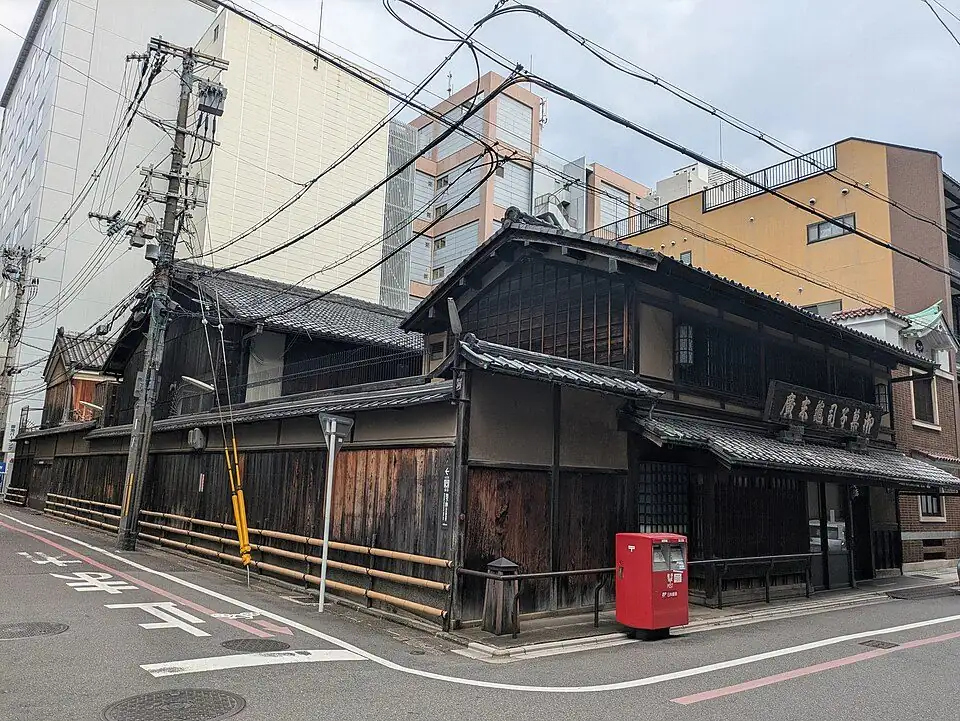
Kamesuehiro
In Japanese: 亀末廣
Est. 1804
Kamesuehiro is a wagashi (traditional Japanese sweets) shop on Aneyakoji-dori in central Kyoto, open since 1804. Its founder, a former maker of tea kettles, opened it as Kameya Suehiro, and in the Edo period it supplied sweets to Nijo Castle and the Imperial Palace. Its signature Kyo no yosuga is a cedar box divided like a small tearoom and filled with dry sweets; the contents change about 14 times a year.
- What to try
- Kyo no yosuga (the “four-and-a-half-mat” box) and Kyo no junitsuki
- Address
- 251 Kurumaya-cho, Nakagyo-ku, Kyoto
- Getting there
- About a 3-minute walk from Karasuma Oike Station (Kyoto Municipal Subway)
- At the shop
- Take out
- Founded
- 1804
- Era
- Edo period
- Food
- Wagashi
About Kamesuehiro
The founder, Kameya Gensuke, made tea kettles in Daigo, Fushimi. In 1804 he moved into the city and opened a sweets shop named Kameya Suehiro. In the Edo period (1603–1868) it supplied sweets to Nijo Castle, where the Tokugawa shoguns stayed, and to the Imperial Palace. Its owners also trained apprentices, and several sweet shops in Kyoto were started by people who learned here.12
After the war, the sixth owner, Yoshida Kozo, reopened the shop with one confectioner and chose to deal with each customer one to one. Requests from nearby kimono merchants for sweets they could not buy anywhere else are said to have led to Kyo no yosuga and Kyo no junitsuki. Kyo no yosuga is a cedar box divided like a four-and-a-half-mat tearoom, holding dry and semi-dry sweets such as gyuhi, kohaku and pressed sugar. Tea people call it “the four-and-a-half mats.”24
The third owner is said to have devised the way of shaping seasonal flowers and plants into dry sweets. Pressed sweets are made by packing the mixture into wooden molds and knocking it out with a mallet. Suri kohaku is made from melted agar with sugar and syrup. For green maple leaves, each two-tone leaf is curved along a rounded bamboo spatula and dried one by one. The contents change with the seasons, about 14 times a year.124
The two-story main building keeps the look it had when the shop opened, with a storehouse over 100 years old beside it. The frame of the shop sign is edged with wooden sweet molds. Tradition says they were used only once, for special orders from the palace and the Tokugawa family. Inside are a wooden counter worn to an amber shine and thick beams. The shop is on the north side of Aneyakoji-dori, one street south of Karasuma Oike Station, about a 3-minute walk. Sweets are, as a rule, sold only at the shop.13
History
Lineage
- Kameya SuehiroName at opening
- KamesuehiroCurrent name
Drawn only from what the sources state.
- 1804
Former kettle maker Kameya Gensuke opens a sweets shop named Kameya Suehiro.
At the shop
Compiled by our editors from public sources. We warmly welcome corrections from the shop.
Nearby
 Est. c. 1624Kameya IoriHigashi dry sweets for the tea ceremony (aruheito sugar candySee this shop →
 Est. c. 1824Fuka (Nishiki shop)Fu-manjuSee this shop →
 Est. 1861Hiiragiya (ryokan kaiseki, Fuyacho)Kyoto kaiseki (meal-only plans available)See this shop →
 Est. 1873Mishimatei (main shop)Kansai-style sukiyaki seared with sugarSee this shop →
Same food
 Est. c. 1349Shiose SohonkeShiose manju (steamed buns with yam and rice-flour dough)See this shop →
 Est. c. 1421Kameya MutsuMatsukaze (baked miso cake)See this shop →
 Est. 1503Kawabata DokiSuisen chimakiSee this shop →
 Est. c. 1569OsekimochiOseki mochi (plain and mugwort rice cakes topped with coarse bean paste)See this shop →
When this shop first opened
1804
222 years since.
- 1802The first volume of Tokaidochu Hizakurige appears
- 1804Founded
- 1853Perry's ships arrive at Uraga
- 2026Today
Each event on the timeline is checked against a source.
See sources
1802: 静岡県立中央図書館「温故知新」十返舎一九と『膝栗毛』; 1853: 外務省「六月三日ヨリ十二日迄異国船進退之図」解説